Context study / ADITUS
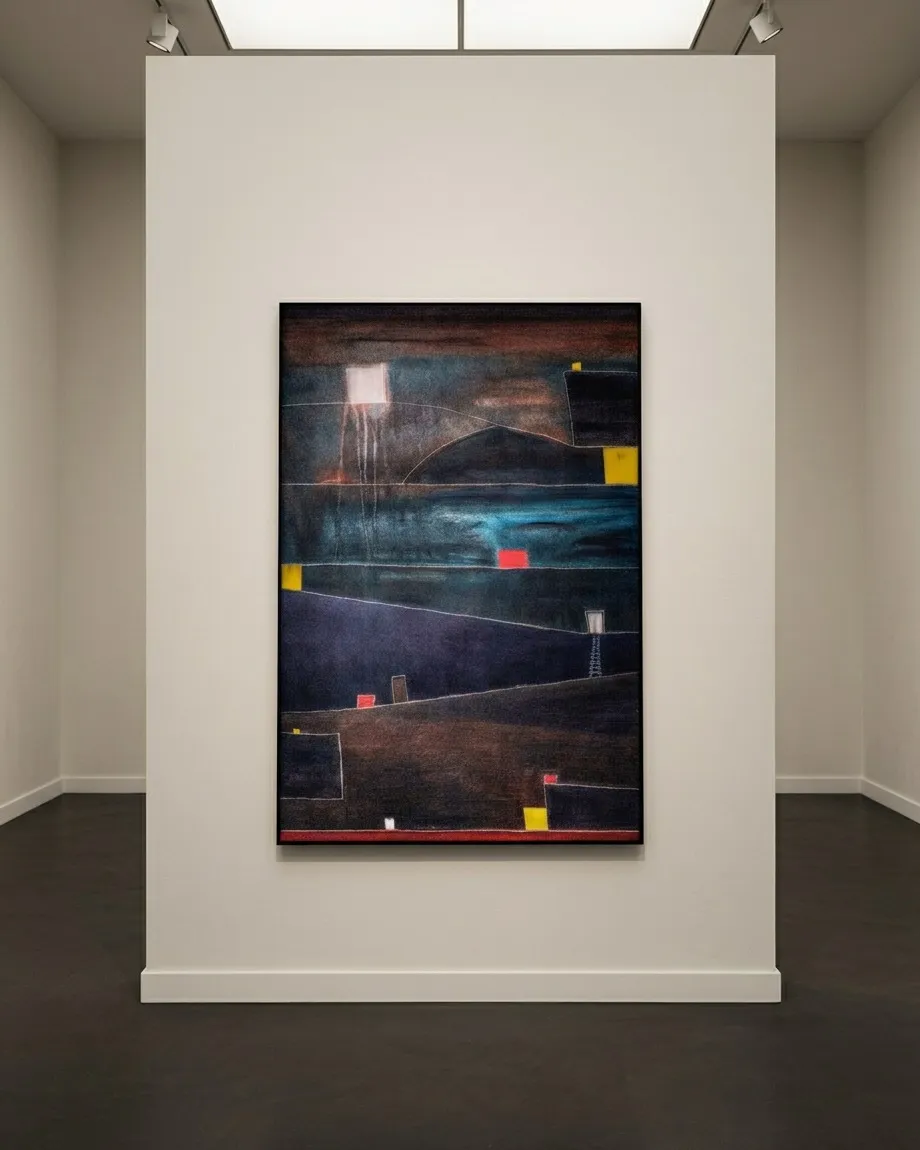
ADITUS by Maurizio Valch, frontal abstract art
The symmetry of the white wall gives ADITUS an almost frontal, ceremonial presence, yet the canvas responds by dispersing its points of support. No internal axis receives the privilege that the presentation seems to promise: the pale rectangle sits high and to the left; the minimal stair is shifted toward the right; the reds and yellows break in at disconnected positions; the dark blocks press in from the edges. This refusal of a central hierarchy belongs to Maurizio Valch’s territorial language, built from fields, divisions, and incisions that do not fix a single perspective. Within the work’s 80 × 120 cm, the turquoise band might offer respite, but its glazes and the lines crossing it make it a zone of passage rather than a stable centre.
Finding one’s bearings therefore requires relinquishing the expectation that a principal sign will resolve the whole. Valch’s experience of travel has left a persistent distinction in his thinking between a route that can be traced and an inner movement whose direction is not given. ADITUS makes this distance felt without translating it into autobiography: the visible indications propose routes, but none prevails over the others. The stair does not organize the territory from its marginal position; nor does the fine arc become an enclosure. The gaze must compose provisional relations among levels, cuts, and small accents, and may discover that the need for a centre is also a habit of perception.
This distribution finds a precise resonance in When the Ground Appeared, where Valch understands territory as a structure that supports and conditions before it can be chosen. ADITUS does not show a uniform ground, but strata that order and disorder at once: each band appears to establish a level, although its inclinations, seepage, and discontinuities shift the reading elsewhere. The Missing Pulse offers another key: the omission of an expected beat does not leave a void, but compels the body to actively complete the rhythm. In a similar way, the absence of a governing focus activates the viewer. What is missing is not information, but the comfort of an instruction; order must be sustained by the person looking.
An affinity with Paul Klee is relevant to the role of these small forms as signs and measures within a broad expanse. The high yellow, the brief reds, the pale frame, and the stair make it possible to gauge distances without becoming a law of composition. Yet where Klee may incline toward a mobile, playful architecture, Valch retains a more restrained gravity: the signs emerge from a nocturnal, eroded surface crossed by matter and cuts. Against the impeccably centred gallery wall, this reserve gains force. ADITUS does not offer a territory that can be mastered from the front; it keeps its decisions distributed, close to the margins, so that looking becomes a matter of establishing connections rather than occupying a commanding point.
- Original artwork
- ADITUS
- Actual dimensions
- 31.5 × 47.2 in / 80 × 120 cm
- Presentation
- Digital contextual visualization
Context references
ADITUS Maurizio Valch · frontal abstract painting in a gallery · vertical minimalist abstract art · painting with red yellow and white rectangles · contemporary art with incised lines · abstract painting with dark strata · large vertical abstract wall artwork · territorial abstraction for minimalist decor
About this visualization
This visualization places the artwork within an architectural context to help collectors and viewers imagine its presence in a real space. It is an interpretive reference, not an exact reproduction: the original work remains the sole authority for scale, color, surface and material presence.