Context study / ADITUS
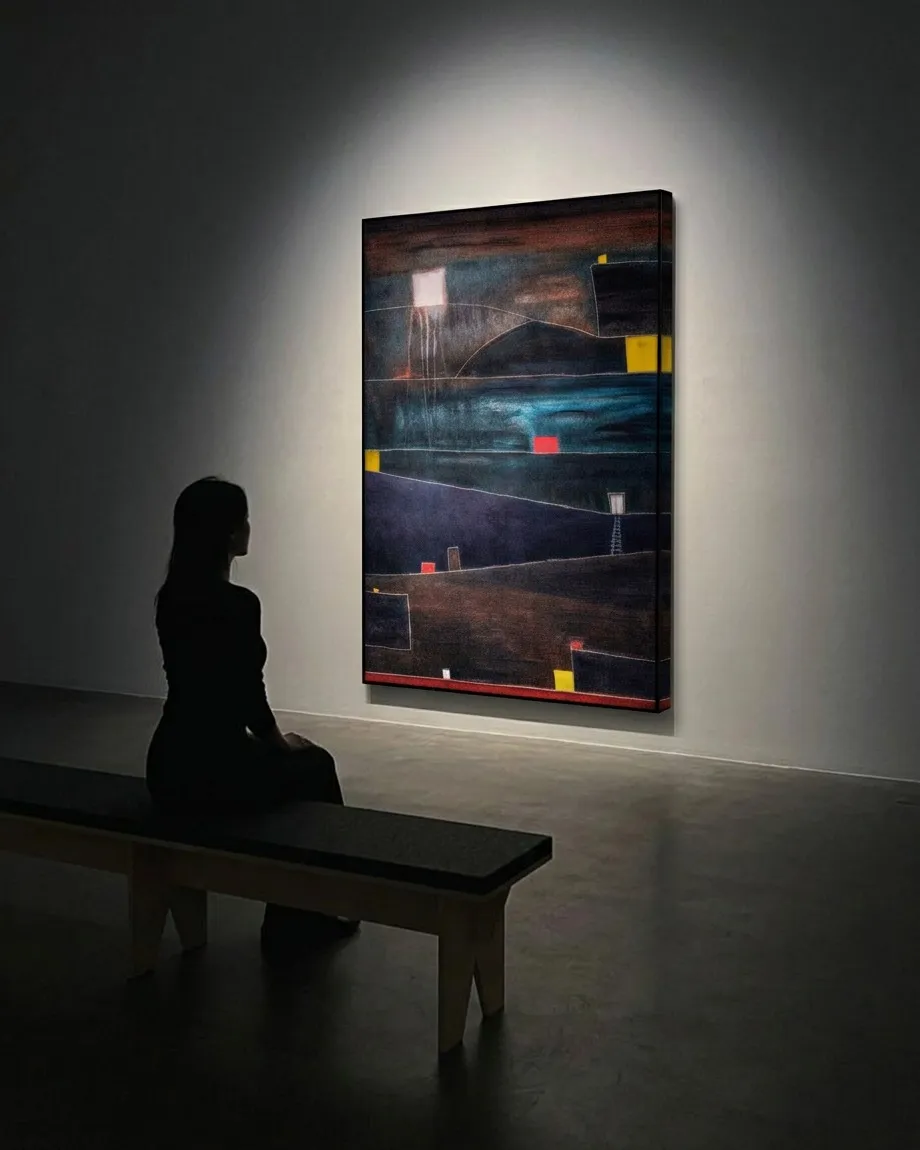
ADITUS by Maurizio Valch, abstract painting in a gallery
The brightness positioned in the upper part of ADITUS does not end within its own rectangle: it lingers in the vertical veils that descend across the dark and turquoise bands. This material drift is decisive because it interrupts, without abolishing them, the incised divisions and horizons that order the canvas. In Maurizio Valch’s language, layers and cuts are not devices superimposed on a prior image, but procedures that make the surface a territory subject to transformation. The reds and yellows, crisp and brief, establish points of attention; the seepage, by contrast, extends an appearance until the boundary between one zone and the next becomes uncertain. Seen from some distance in the gallery, its 120 cm verticality makes this descent legible as a duration rather than an isolated effect.
The delay proposed by the painting also finds a restrained echo in a recurring concern of the artist: the difference between a fact and the interpretations that adhere to it. The pale rectangle may be received simply as a luminous presence; yet its traces compel the gaze to remain after the first recognition. They do not offer a fixed psychological meaning or turn the pictorial field into confession. Rather, they make perceptible how something minimal can continue to act without becoming a heroic event. The seated figure before the painting underscores this condition of waiting: the work does not demand that one resolve what this light is, but that one notice how its material passes through levels that had seemed already established.
The essays “From Dream to Territory” and “When the Ground Appeared” help situate this persistence within LIMINA. Valch writes that, in this series, space approaches the threshold through drips, early incisions, and transitional zones; the ground gains the capacity to support and order, but loses the authority to definitively fix what occurs upon it. ADITUS condenses this problem on a contained scale: beneath the pale form, the pigment seems to have retained the movement of a fall that does not fully obey the internal architecture. The structure remains standing—the bands, the curve, and the small signals hold their positions—but it can no longer present itself as a closed system. The painting’s time does not move toward resolution: it remains held within this infiltration.
Its affinity with Antoni Tàpies illuminates the condition of a marked surface, particularly where the painting reveals glazes, cuts, and worn areas as the memory of material actions. Yet ADITUS departs from the almost mural gravity that may be associated with Tàpies: its incisions and seepage do not close the field into wounded skin, but sustain a territorial organization of levels, possible accesses, and distances. The upper light neither dominates nor redeems this territory; it merely touches it and continues downward. The work’s singularity lies in this faint trace: an appearance that has already occurred remains active, altering what it encounters without ever conquering it.
- Original artwork
- ADITUS
- Actual dimensions
- 31.5 × 47.2 in / 80 × 120 cm
- Presentation
- Digital contextual visualization
Context references
ADITUS Maurizio Valch · abstract painting with vertical glazes · dark abstract art with turquoise · contemporary painting with red and yellow · vertical abstract artwork in a gallery · layered-surface painting · contemporary minimalist wall art · territorial abstraction with layers of colour
About this visualization
This visualization places the artwork within an architectural context to help collectors and viewers imagine its presence in a real space. It is an interpretive reference, not an exact reproduction: the original work remains the sole authority for scale, color, surface and material presence.