Context study / ADITUS
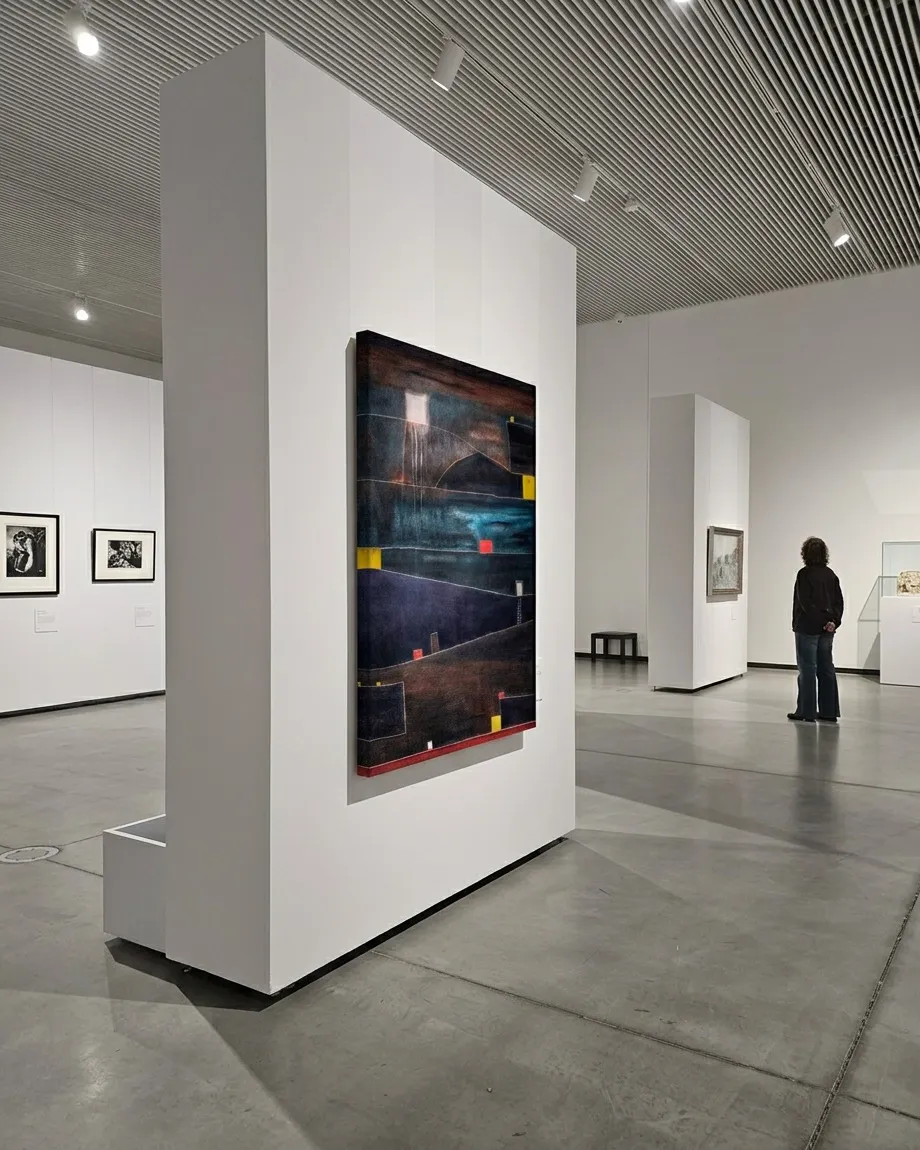
ADITUS by Maurizio Valch on a museum pillar
Interrupted before it can fulfil its promise of shelter, the pale arch in ADITUS introduces a fragile curve into a field governed by bands, rectangles, and cuts. Its upper course crosses the dark and turquoise area, but the black block at the right edge stops it: it neither marks out a room nor organizes a legible route. This failure of closure is decisive. In Maurizio Valch’s language, divisions and incisions are not mere drawings applied to an image, but interventions that turn the surface into a territory of boundaries, traces, and possible connections. The curve is thus subject to the same material condition as the sloping strata and lower lines: it may suggest protection, but cannot consolidate it.
The uncertainty of this gesture echoes a recurring distinction in the artist’s thought: an outer path can be traced, while inner movement does not guarantee direction. The Latin title refers to access, but the painting avoids offering an already resolved entrance. Beneath the arch, the small luminous signals and barely indicated staircase offer points of attention without becoming instructions. One may read here a resistance to turning the search into a narrative of arrival: an opening is not yet an exit, and a form that seems to shelter may also leave what it contains exposed. The experience remains at the edge of a decision that does not become doctrine.
In “When the Ground Appeared,” Valch describes territory as a structure able to support, separate, and order, but also insists that no ground is neutral: it precedes those who inhabit it with its boundaries, routes, and conditions. ADITUS brings that idea to the threshold of LIMINA. The bands do not form a firm base; their slopes, seepages, and shifts in density destabilize the distribution of space. The arch does not deny this instability or arrive to repair it. Instead, it introduces a suspension within the existing order: the possibility that boundaries are not only what prevents passage, but also the place where a passage must still discover its form.
The oblique view across the pillar intensifies this reserve. From a distance, the vertical canvas asserts itself as a compact plane, almost a territorial slab suspended within the white architecture; up close, the arch loses any function as a diagram and regains the vulnerability of a line held back by matter. A specific affinity can be drawn with Barnett Newman in the capacity of a minimal intervention to alter the expanse of a field. Yet where Newman’s division may assert a decisive vertical presence, Valch allows the line to curve, break off, and negotiate with eroded strata. His access does not separate two clear domains: within the cut, it keeps open the question of what might still be crossed.
- Original artwork
- ADITUS
- Actual dimensions
- 31.5 × 47.2 in / 80 × 120 cm
- Presentation
- Digital contextual visualization
Context references
ADITUS Maurizio Valch · abstract painting in a museum · abstract art with arch and geometry · contemporary threshold painting · vertical abstract artwork for a gallery · painting with turquoise band and dark blocks · contemporary territorial art · abstract painting installed on a pillar
About this visualization
This visualization places the artwork within an architectural context to help collectors and viewers imagine its presence in a real space. It is an interpretive reference, not an exact reproduction: the original work remains the sole authority for scale, color, surface and material presence.