Context study / ADITUS
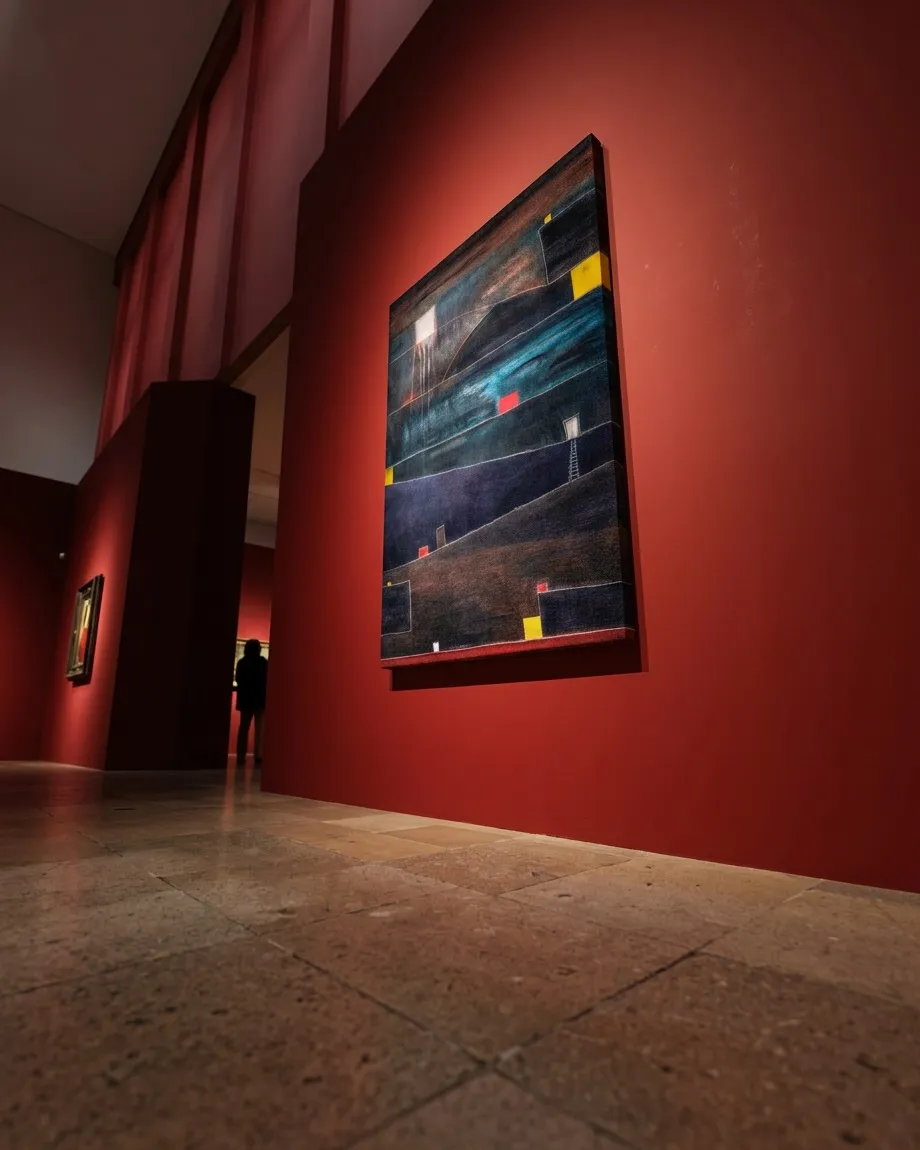
ADITUS by Maurizio Valch in a gallery corridor
The corridor finds in ADITUS not an image that accompanies its movement forward, but an obstacle to the inertia of walking. Seen in foreshortening and from a low vantage point, the 80 × 120 cm vertical canvas stands clearly apart from the floor and takes on the weight of a plane held still before one’s path. Its dark, slanted, overlapping bands retain a territorial discipline, yet refuse to stabilize a perspective. The compressed turquoise band, the small red, yellow, and white rectangles, the empty frame, and the drawn staircase introduce measures and possible connections; the incisions and oblique boundaries make them discontinuous. In Maurizio Valch’s language, these divisions do not amount to recognizable architecture: they sustain a territory in which structure and transformation remain active at once. For this reason, the Latin title, associated with access, does not announce an available doorway; it concentrates the difficulty of knowing where passage truly begins.
Moving along an outer path and finding an inner direction are experiences the artist himself has distinguished without conflating them. His journeys and displacements inform a sensibility attentive to intervals—fatigue, waiting, the condition of belonging neither wholly to the place left behind nor to the one being sought—without turning the painting into autobiography. In ADITUS, the staircase suggests a concrete action and yet offers no route the eye can complete. That frustration does not amount to defeat: it may be read as a suspension of immediate explanations, close to his interest in attending to the fact before thought covers it with interpretations. The visitor pauses because the painting does not allow its signs to become instructions; one must remain before an incomplete possibility.
In “From Dream to Territory,” Valch describes the staircase in his early series as a sign of ascent that promises neither automatic progress nor salvation. To climb entails leaving a previous position and taking responsibility for one’s own gaze; it also entails a solitude that cannot be delegated. ADITUS shifts that idea into a more ambiguous scene: the small staircase is absorbed into a field of bands, voids, and uneven levels that do not authorize continuous ascent. The lateral presentation intensifies this condition. While the body has a real corridor along which to continue, the eye encounters a geography that cannot be traversed. Thus, LIMINA’s threshold becomes less a boundary between two places than a time of delay, when inherited orientation no longer suffices and another has not yet appeared.
Paul Klee offers a specific affinity for understanding the function of minimal signs: in both cases, small forms can measure the scale of an expanse and activate an elemental architecture without fully fixing it. But where Klee often lets such signs produce lightness or play, Valch subjects them to a denser, more nocturnal and eroded condition. ADITUS’s luminous rectangles do not relieve the mass of the strata; they make it harder to cross, because they appear as warnings whose code is missing. Isolated on the side wall, the canvas thus retains an almost physical presence within the passage: it does not ask the visitor to imagine a destination behind its bands, but to acknowledge the moment before every movement must stop and look again.
- Original artwork
- ADITUS
- Actual dimensions
- 31.5 × 47.2 in / 80 × 120 cm
- Presentation
- Digital contextual visualization
Context references
ADITUS Maurizio Valch · abstract painting in a gallery corridor · vertical abstract art with turquoise · painting with dark bands and red accents · contemporary geometric art for a wall · abstract painting with a small staircase · contemporary territorial abstraction · artwork in a red-walled gallery
About this visualization
This visualization places the artwork within an architectural context to help collectors and viewers imagine its presence in a real space. It is an interpretive reference, not an exact reproduction: the original work remains the sole authority for scale, color, surface and material presence.