Context study / ADITUS
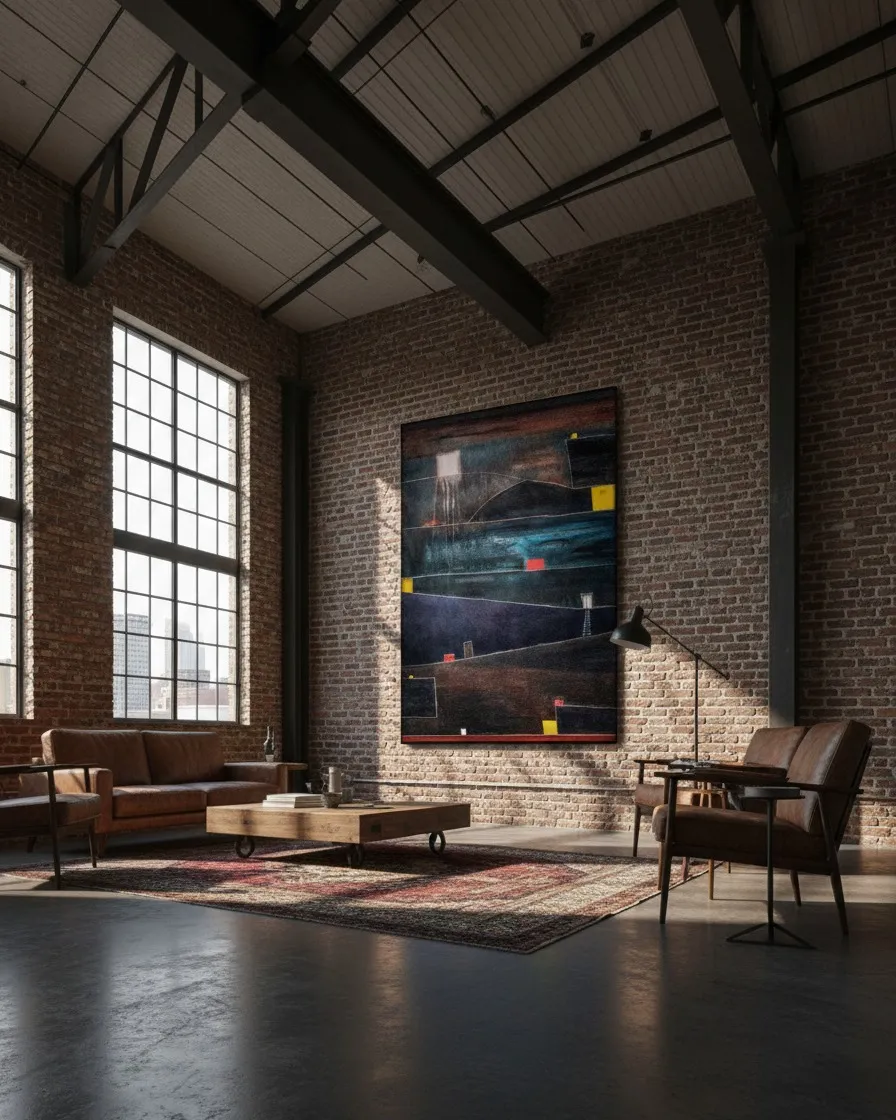
ADITUS by Maurizio Valch in a brick loft
The staircase barely manages to assert itself before being absorbed by the dark bands of ADITUS. In the vertical 80 × 120 cm format, the slanting divisions, turquoise band, and violet, rust, and black fields do not arrange themselves according to a legible architectural scale: they establish expanses against which the small run of steps, the frames, and the red, yellow, or white rectangles continually shift in perceived size. This instability belongs to Maurizio Valch’s territorial language, made of contained horizons, blocks, and incised lines that organize without enclosing. The low-hung presentation beneath the loft’s elevated structure intensifies the mismatch: the canvas does not offer a miniature building, but a vertical field in which the eye must search for where to position itself.
Measuring one’s own place against an expanse that offers no fixed measure is an experience close to the questions running through his thought. Travel has left Valch with a distinction between a path that can be drawn and an inner movement whose direction remains uncertain; that difference helps us look at the staircase without turning it into an emblem of improvement or ascent. In ADITUS, the direction is given and yet insufficient. The step, the luminous rectangle, and the incomplete arch offer concrete points of reference, but none can dominate the breadth around them. The painting thus retains an attention to the visible fact—a sign, a boundary, a possible connection—before the mind turns it into a total explanation.
The essay When the Ground Appeared places LIMINA at the moment when territory ceases to be mere suspension and begins to support, separate, and order, without thereby becoming stable. ADITUS makes that condition perceptible through a precise economy: its strata are not a continuous ground on which to stand, but levels that slope, break off, and seep into one another. The scale of the smaller forms introduces a human presence without a figure, while also exposing its precarity before an order whose points of reference keep shifting. The threshold, as the essay frames it, is neither arrival nor departure; it is the interval in which what has been inherited still acts while a new orientation has not yet fully emerged. The isolated staircase gains its force there: it allows us to imagine passage, but not to verify a destination.
Paul Klee offers a specific affinity for understanding the function of these tiny signs: minimal geometry can activate distance and scale within a space much larger than itself. In ADITUS, however, the lit rectangles do not lighten the territory or turn it into a constructive play of forms. Their brief glow, surrounded by dark material and glazes, makes them warnings without instructions. Valch thus shifts the question from what these forms represent to what they do to those who look at them: they compel a recalculation of the distance between a body and a field that admits no definitive proportion. Beneath the industrial height of the setting, that recalibration remains open; every sign seems near and distant at once.
- Original artwork
- ADITUS
- Actual dimensions
- 31.5 × 47.2 in / 80 × 120 cm
- Presentation
- Digital contextual visualization
Context references
ADITUS Maurizio Valch · abstract painting for a loft living room · wall art for a brick wall · vertical abstract painting 80 x 120 cm · abstract painting with staircase and geometry · contemporary abstract landscape · minimalist art for an industrial interior · violet turquoise and rust abstract painting
About this visualization
This visualization places the artwork within an architectural context to help collectors and viewers imagine its presence in a real space. It is an interpretive reference, not an exact reproduction: the original work remains the sole authority for scale, color, surface and material presence.