Context study / ADITUS
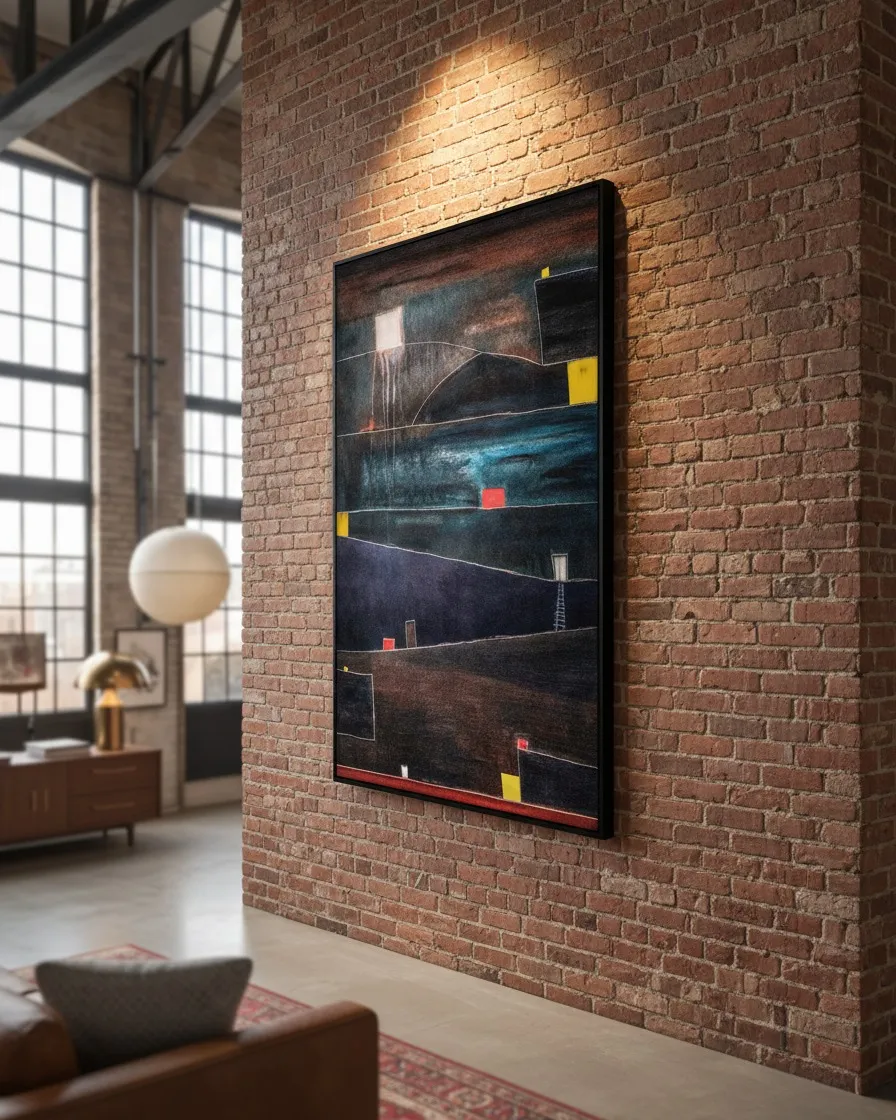
ADITUS by Maurizio Valch in an Industrial Brick Interior
Hung in its vertical 80 × 120 cm format, ADITUS does not present itself as a view that can be taken in all at once: it compels the eye to descend and rise again through discontinuous levels. The dark upper field, compressed turquoise band, violets, and lower earth tones do not form calm strata; their slanting edges unsettle each pause of the gaze. The small red, yellow, and white accents shift in scale according to the level from which they are viewed, while the staircase, placed halfway up, barely sustains a direction before being absorbed by the whole. This economy of planes, incisions, and divisions extends Maurizio Valch’s territorial language: the line intervenes in the surface as a boundary or route, but does not establish a legible cartography. In this side presentation against the brick wall, the canvas’s height accentuates this segmented work; approaching it makes the signs discernible, but does not bring them together into a single route.
The uncertainty of the route has a particular resonance within Valch’s thinking, which attends to the difference between an outer path—one that can be traced—and an inner movement whose direction remains unknown. That distinction does not turn the staircase into autobiography or a closed psychological allegory. Rather, it makes clear why its reduced scale is decisive: it neither crowns the territory nor promises an exit, but introduces a vulnerable possibility among areas that exceed it. The Latin title refers to access, yet the painting shifts the idea of entry away from a conclusive gesture towards intermittent attention. Each point of reference seems sufficient for an instant and then immediately calls for another reading.
In “When the Ground Appeared,” Valch writes that territory does not arrive as a neutral foundation: it supports, separates, and conditions what can be organized upon it. ADITUS brings that idea to LIMINA’s own threshold. Its bands are not merely superimposed surfaces; they establish positions from which something may emerge, descend, or remain suspended. The essay understands the loss of orientation as a condition of transformation, rather than an error the image must correct. From this perspective, the drips falling from the pale upper form and the incisions crossing the levels do not destroy the compositional order: they show that its divisions are subject to displacement. The gaze proceeds by intervals because the ground itself no longer offers secure continuity.
A specific affinity with Paul Klee helps clarify the role of the luminous rectangles: they operate as minimal signs and shifting measures within a broad expanse. In ADITUS, however, they do not activate a playful architecture or a transparent system. The yellow signal by the edge, the red one suspended above the central band, and the small white form near the staircase retain an almost indicative intensity, but offer no instruction. Valch places them in a denser atmosphere, where each mark alters distance without resolving it. Access thus becomes less a matter of reaching a point than of accepting perception’s renewed beginning: pausing before one level, losing the previous reference, and searching again.
- Original artwork
- ADITUS
- Actual dimensions
- 31.5 × 47.2 in / 80 × 120 cm
- Presentation
- Digital contextual visualization
Context references
vertical abstract painting on brick wall · abstract art for industrial interior · decorating with a large abstract painting · vertical artwork in loft-style living room · contemporary art on brick wall · abstract painting mockup in industrial interior
About this visualization
This visualization places the artwork within an architectural context to help collectors and viewers imagine its presence in a real space. It is an interpretive reference, not an exact reproduction: the original work remains the sole authority for scale, color, surface and material presence.