Context study / ADITUS
ADITUS — Context Study
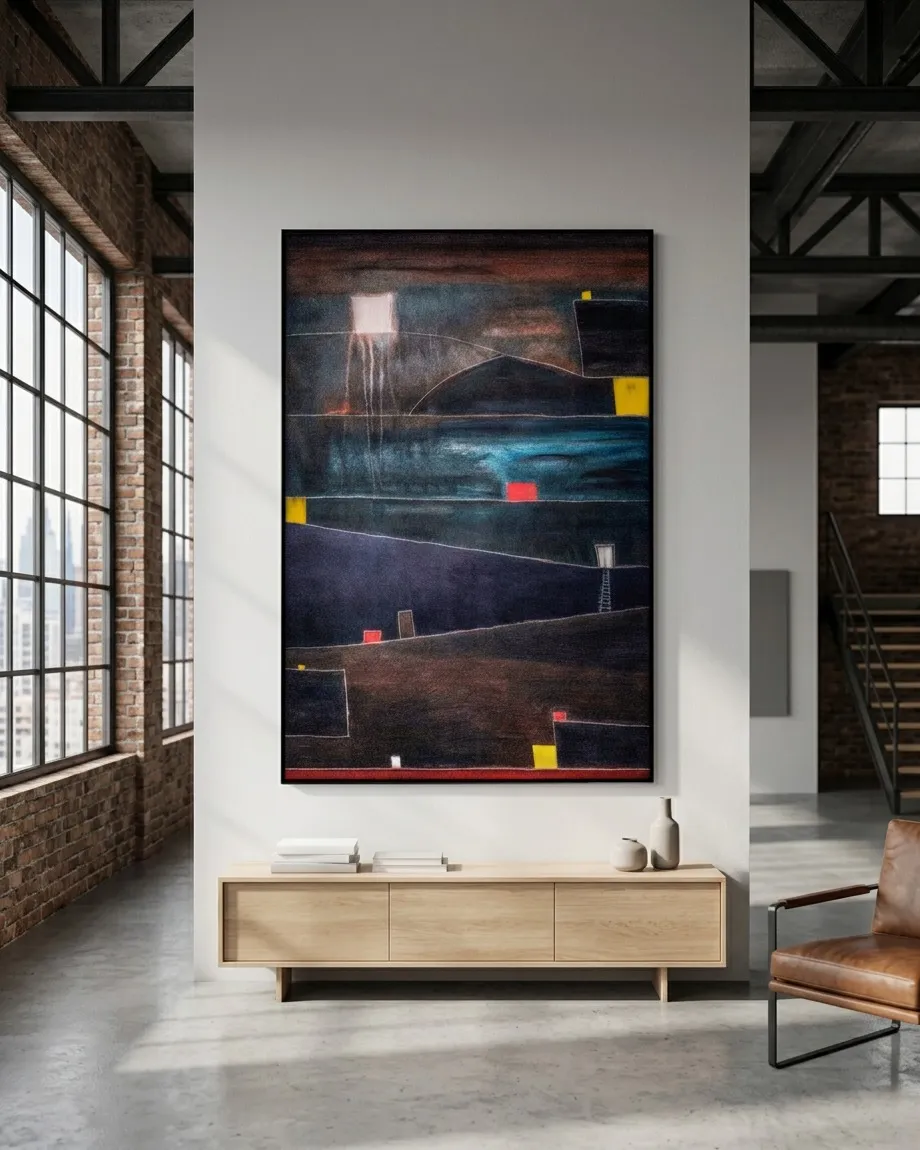
Natural light, falling upon ADITUS, accentuates the complexity of its surface and its deep palette of blues and browns. This illumination highlights the contrast between the vast dark fields and the vibrant red and yellow accents that emerge with intensity. The composition is structured by distinct horizontal divisions, creating visual tension with the verticality of subtle elements like drips and a small ladder, suggesting a latent movement. The artwork, executed in acrylic and oil on canvas, reveals a surface crafted with layers, impasto, and incisions that build a material and stratified territory. ADITUS invites unhurried contemplation, where every form and line draws a threshold towards an enigmatic depth. Its understated presence radiates a contained and mysterious atmosphere.
- Original artwork
- ADITUS
- Actual dimensions
- 80 × 120 cm / 31.5 × 47.2 in
- Presentation
- Digital contextual visualization
Context references
Original abstract painting · Contemporary abstract artwork · Maurizio Valch abstract art · Blue and brown abstract piece · Abstract acrylic and oil on canvas · Vertical painting for loft · Textured material art · Painting with geometric shapes · Contemporary brutalist painting · Minimalist abstract art for collectors · Acquire original contemporary art · Large format XL abstract painting · Painting with horizontal divisions · Art for modern industrial spaces · Abstract territorial work for architecture · Abstract canvas with layers and strata
Collector note
This visualization presents the artwork at its declared physical scale in an architectural context. The original work remains the authority for color, surface, dimensions and material presence.