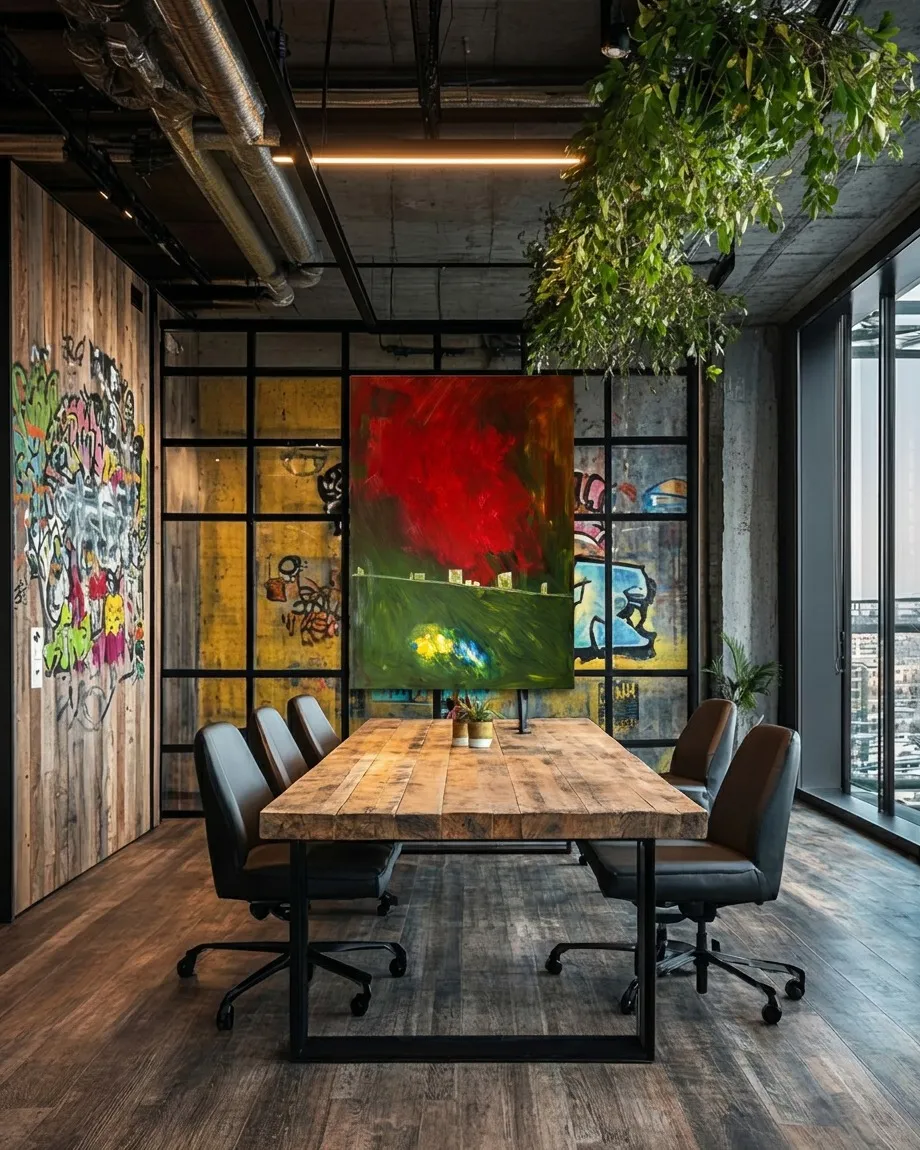
Context study / A THEORY OF LIGHT AND SHADOWS
Abstract Painting in Meeting Room | A Theory of Light and Shadows
In the transition toward vision loss, the world does not dissolve into a uniform nothingness, but thickens into a geography of reliefs, resistances, and edges. In A THEORY OF LIGHT AND SHADOWS, light and shadow abdicate their intangible nature to behave as physical bodies of overwhelming weight. This painting proposes a tactile cartography that recalls the blindness of Borges's maker: an attempt to measure space not through optical glare, but through pressure, the wound, and the permanence of the boundary. Above, a dense red mass violently pushes the plane of the painting, igniting thought in a fire that seeks to break through downward, where the canvas sinks into a pit of abyssal greens and dark sediments. In the middle of this collision, a horizontal incision functions as a border and support, a physical suture made by one who no longer trusts eyes and prefers to traverse the world with fingertips.
I work with color fields, layers, incisions, divisions, horizons, and elemental forms. For me, painting is opposing a material resistance to the emptiness of the canvas, searching for a stratum hidden beneath the accumulation of paint. The incisions I make in the plane are not mere lines added to the surface: they penetrate the pictorial matter with the force of a cutting tool and remain there as traces, boundaries, or paths within it. I need to feel that physical opposition, the furrow that metal tears from wet or dry pigment to expose the preceding layer. The red color dominating the upper half is not a decorative chromatic choice; it is a dense force that I must appease, contain, or divide through a stroke that cuts the plane and shapes a ground where form can truly begin to sustain itself.
The incision dividing the space is not empty: aligned upon it is a precarious row of quadrangular structures, small geometric landmarks acting as stations or thresholds of memory. The contrast in scale is drastic; against the immensity of the red cloud threatening to consume everything, these small boxes of light resist in a fragile equilibrium, as if they were the final repositories of an intelligible order. Below them, time seems to have stopped or sedimented into successive layers of greens and earth tones, leaving a blue and yellow reverberation trapped at the bottom—a light residue that no longer shines outward, but pulses from within a geological pit. It is the erosion of the matter itself that reveals these submerged lights, demonstrating that shadow in this territory is not an absence of vision, but the tactile accumulation of everything that once existed and now refuses to disappear.
I construct territories where form appears, erodes, divides, remains, or begins to transform. I do not seek to illustrate a prior idea or explain a psychological experience, but stepping back from the easel, I discover that the painting has ended up configuring a territory I no longer directly control. That line of small blocks aligned on the dividing edge, which I initially traced as an attempt to delimit disorder, now questions me from its own silence. What remains trapped in the lower pit of the canvas no longer belongs to my will; it is an autonomous residue that has taken on its own pictorial existence in space. I have scratched the matter to find a certainty, and what I have left exposed is a strange topography, a map of shadows where I myself must learn to walk blindly.
- Original artwork
- A THEORY OF LIGHT AND SHADOWS
- Actual dimensions
- 31.5 × 47.2 in / 80 × 120 cm
- Presentation
- Digital contextual visualization
Context references
boardroom paintings · industrial style office decor · contemporary art in workspaces · textured abstract painting · maurizio valch artworks
About this visualization
This visualization places the artwork within an architectural context to help collectors and viewers imagine its presence in a real space. It is an interpretive reference, not an exact reproduction: the original work remains the sole authority for scale, color, surface and material presence.