Context study / A THEORY OF LIGHT AND SHADOWS
A Theory of Light and Shadows in Museum | Maurizio Valch
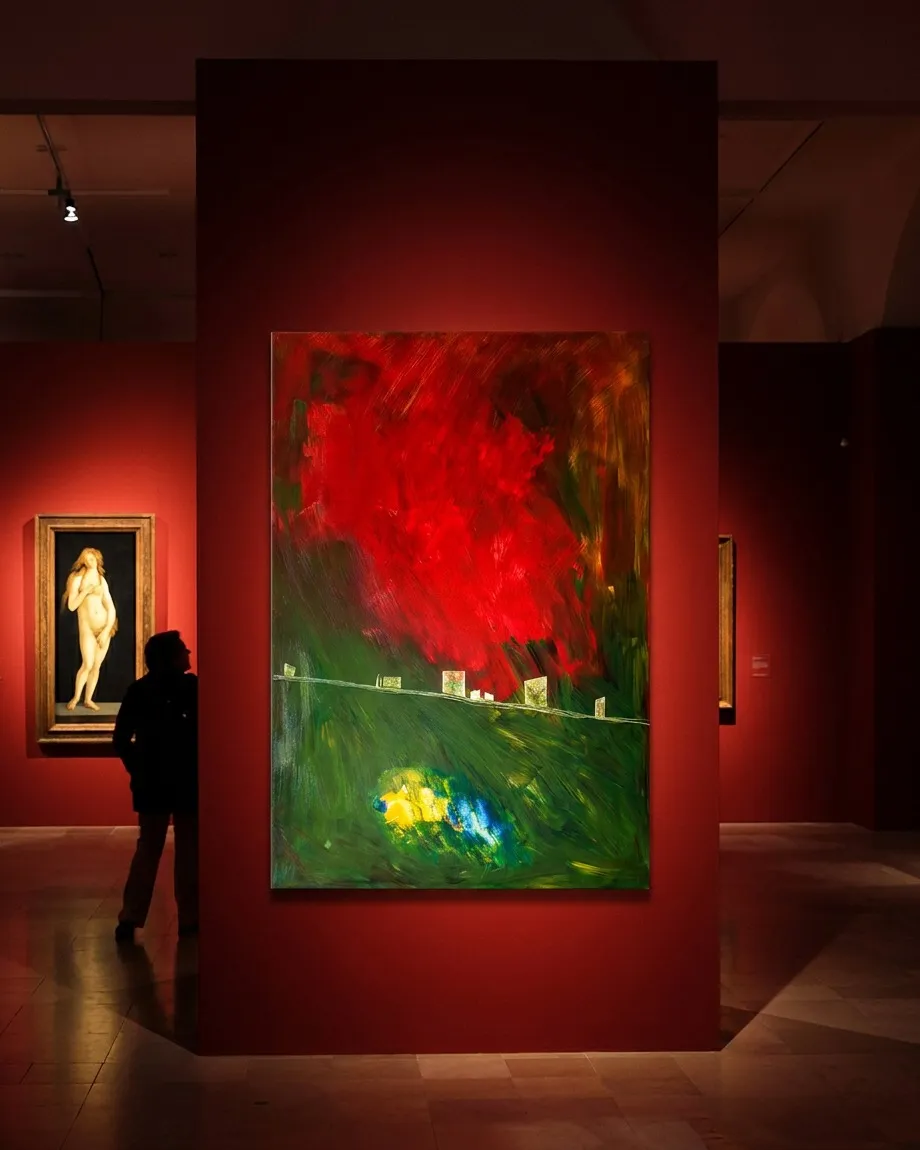
There is an almost mineral rigor in the idea that an entire destiny cannot fit into a summary. In Other Inquisitions, Jorge Luis Borges suggested that any attempt to synthesize a life—to reduce it to an ordered succession of facts, dates, and decisions—is a surrender to the impossibility of the infinite. An existence is not summarized; it accumulates, contradicts, and overlaps. Before A THEORY OF LIGHT AND SHADOWS, that same resistance to synopsis unfolds on the canvas. The painting does not illustrate a Borgesian concept, but shares its very suspicion: that the truth of a presence is not found in the clarity of its silhouette, but in the density of its strata. Above, a violent and almost solid mass of crimson red presses down upon a territory of swept, nocturnal greens. In the center, a very thin, horizontal incised line holds a series of small, suspended light blocks, as if they were the closed pages of an infinite volume or the geometries of a human scale attempting to measure an unfathomable abyss.
When I drag the palette knife to open that horizontal groove in the middle of the canvas, I do not seek to draw a line, but to break the continuity of the paint. The incisions in my work are not additions to the surface; they penetrate the wet matter and remain there as physical boundaries, scars dividing the visual territory. Facing this eighty-by-one-hundred-and-twenty-centimeter format, I felt that the density of the dark green needed a drastic cut, a border to contain the tide of crimson red collapsing from above. Color has a real, almost geological weight that pushes downward. That incision acts as an invisible wall, a support where I placed those small light blocks one by one, seeking a purely physical point of balance in the midst of the chromatic storm. There is no intention to narrate here; there is an urgency to delimit and sustain.
Time in the studio passes with a slowness that contrasts with the speed at which thought attempts to grasp the work. During the afternoons, when the Mediterranean light fades and filters in at a low angle through the windows, those small blocks suspended over the incision change character: they no longer seem like human constructions or mute pages, but fragments of a structure that barely survives the pressure of the material. Below that border line, in the lower zone of dark greens, pulses a yellow and electric blue core that resists description. It is a sediment that survives under layers of dark glazes, a luminous trace that the viewer perceives without being able to fully decipher. Words run out before reaching that depth; painting becomes there an insurmountable obstacle to any intellectual translation, embodying the certainty that the presence of a being always retains a redoubt that escapes the gaze of others.
I looked at the painting again today, months after finishing it, under a cold illumination that reveals details that went unnoticed in the studio. I wonder now if that great red mass floating in the upper section is a manifestation or an intrusion consuming everything. Sometimes I doubt the apparent stillness of the incised line; it seems to me that those small light blocks are not supported by it, but are falling slowly, as if the border I traced were yielding under the weight of the crimson. At first, I thought I was ordering a territory, but now I discover that the painting has imposed its own logic of opposing forces. Perhaps the true conflict is not between light and shadow, but in that lower band where the blue and yellow insist on shining from the depth, indifferent to the violent tension occurring above. I have learned to accept this discrepancy as part of the work.
In the end, A THEORY OF LIGHT AND SHADOWS functions as a map without scale of the ungraspable. The coexistence of the burning mass, the green abyss, the luminous secret pulsating below, and the fragile architecture aligned on the wound of the canvas reminds us that a being cannot be explained all at once. Each stratum of matter demands a different reading time, a speed of perception that disrupts any attempt to capture the whole in a single glance. The painting sustains this multiplicity without resolving it, allowing the mystery of the presence to remain intact, suspended in the physical tension of its colors and boundaries.
- Original artwork
- A THEORY OF LIGHT AND SHADOWS
- Actual dimensions
- 31.5 × 47.2 in / 80 × 120 cm
- Presentation
- Digital contextual visualization
Context references
abstract painting in museum · contemporary art on red walls · museum art exhibition · maurizio valch theory of light and shadows
About this visualization
This visualization places the artwork within an architectural context to help collectors and viewers imagine its presence in a real space. It is an interpretive reference, not an exact reproduction: the original work remains the sole authority for scale, color, surface and material presence.