Context study / A THEORY OF LIGHT AND SHADOWS
A Theory of Light and Shadows on Exhibition | Maurizio Valch
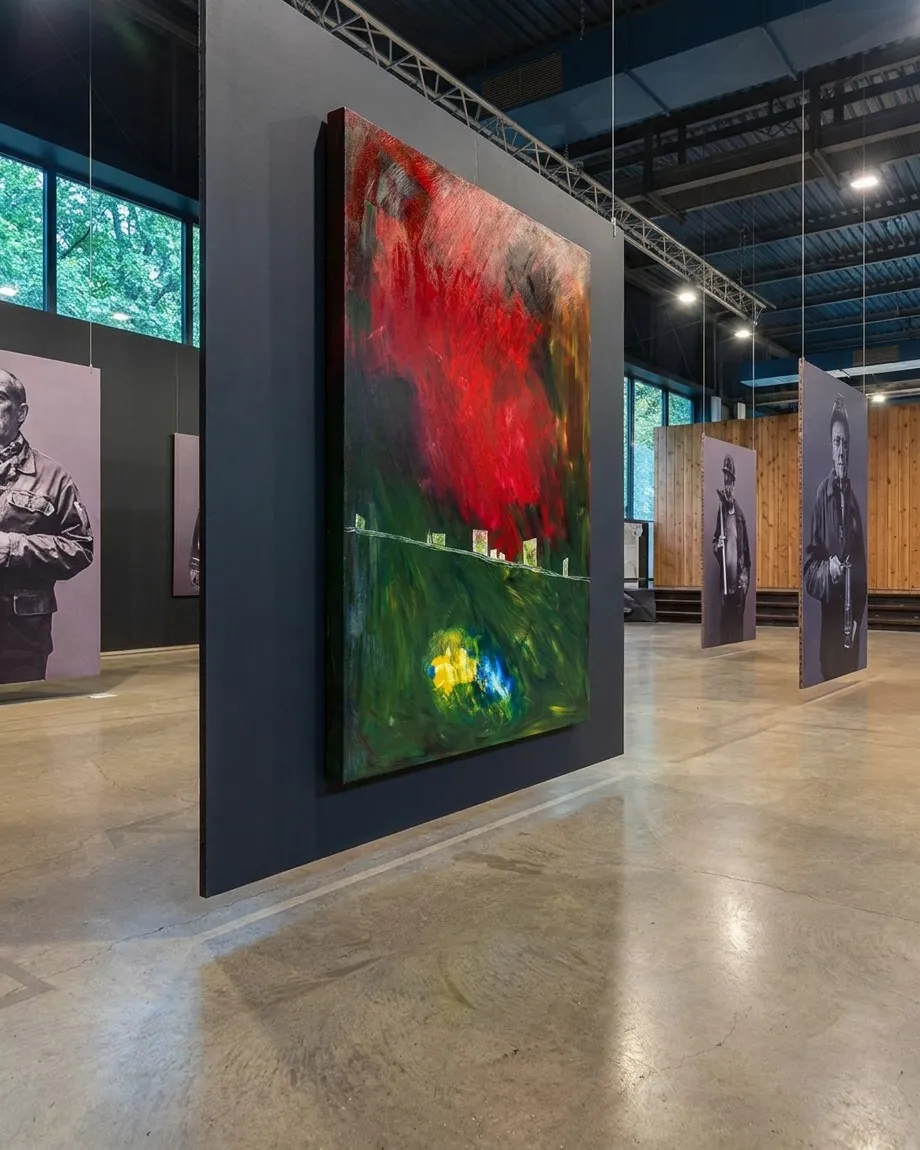
A large upper mass of dense, vibrant crimson seems to float or press down upon a deep, textured green territory. This is the first thing that asserts itself when looking at A THEORY OF LIGHT AND SHADOWS. There is no soft transition here, but a tense proximity between two chromatic forces claiming the space. Right at the boundary where both fields meet, a thin incised line cuts across the horizontal of the canvas. Settled upon it, as if suspended in a precarious balance, is a row of small quadrangular blocks—minimal monoliths that introduce an almost microscopic scale against the atmospheric immensity surrounding them. Below that same line, submerged in the green twilight, a flash emerges: a small cavity of yellow, white, and blue light that seems to pulse from the depth of the stratum. The painting thus presents itself as a geography of brutal contrasts: the immense and the minuscule, the pressure of a red storm, and the persistence of a linear order attempting, unsuccessfully, to contain it.
I prepared the support knowing that the material had to resist the force of the gesture. The green is not a background; it is an accumulation of oil and acrylic that I dragged with the palette knife, allowing the drying irregularities to create their own cracks and reliefs. While the surface was still fresh, I pressed the tool to carve that horizontal line. I did not want to draw a border, but to puncture the color, opening a physical incision in the paint. The incision does not decorate the painting; it divides and sustains it. It is a trace of passage, a groove where the material is displaced and reveals what lies beneath. Each small block of paint I placed on that line was an attempt to fix a coordinate, a visual anchor so that the eye does not get lost in the density of the crimson descending like a threat or a promise over the territory.
The coexistence of these two scales—the grand chromatic void and the precision of the geometric row—immediately evokes the Borgesian suspicion that the universe is an indecipherable map whose clearest signs are also the most silent. In The God's Script, the prisoner searches for the magic formula in the spots of a jaguar's skin, believing that the immensity of a divine purpose can be reduced to a visible alphabet. In A THEORY OF LIGHT AND SHADOWS, those small monoliths aligned over the green abyss suggest a similar effort: the human will to trace a syntax, to erect a rational architecture in the midst of chaos. But the theory proposed by the title is contradictory. Order is not provided by the grey geometry of the line, but by the anomaly of the yellow and blue flash pulsing below—a light that does not come from an external sun, but seems trapped, like a phosphorescent mineral, between the strata of the damp earth.
I looked at the painting again today, months after hanging it in this room, and found myself searching once more for the origin of that point of yellow light in the lower section. When I painted it, I thought I was solving a problem of visual weight, a need to balance the upper red mass with a focus of attention at the base. Now I suspect the painting was defending itself against my own will for order. That blue and yellow vibration refutes the rigidity of the incised line; it is an organic element that refuses to be aligned or measured. Painting has that capacity to resist the original plan of the studio. One traces a theory of light and shadows, a structure one believes to master, and the canvas ends up revealing that the true light always springs from the area we intended to leave in shadow.
In the end, A THEORY OF LIGHT AND SHADOWS is sustained by this unresolved tension. The crimson storm keeps pressing, the incised line continues to hold its indecipherable alphabet of small blocks, and the lower flash still pulses beneath the green surface. The painting does not illustrate a concept or explain how clarity and darkness interact; it gives a physical existence to that dispute. It leaves us at the boundary of what we can order with our lines and what we must accept as an untamed presence—a matter that lives and transforms far beyond our explanations.
- Original artwork
- A THEORY OF LIGHT AND SHADOWS
- Actual dimensions
- 31.5 × 47.2 in / 80 × 120 cm
- Presentation
- Digital contextual visualization
Context references
contemporary art exhibition · abstract painting in industrial gallery · art exhibition setup · maurizio valch incarnate exhibition
About this visualization
This visualization places the artwork within an architectural context to help collectors and viewers imagine its presence in a real space. It is an interpretive reference, not an exact reproduction: the original work remains the sole authority for scale, color, surface and material presence.