Context study / VIA SOLIS
VIA SOLIS - Original Contemporary Abstract Artwork
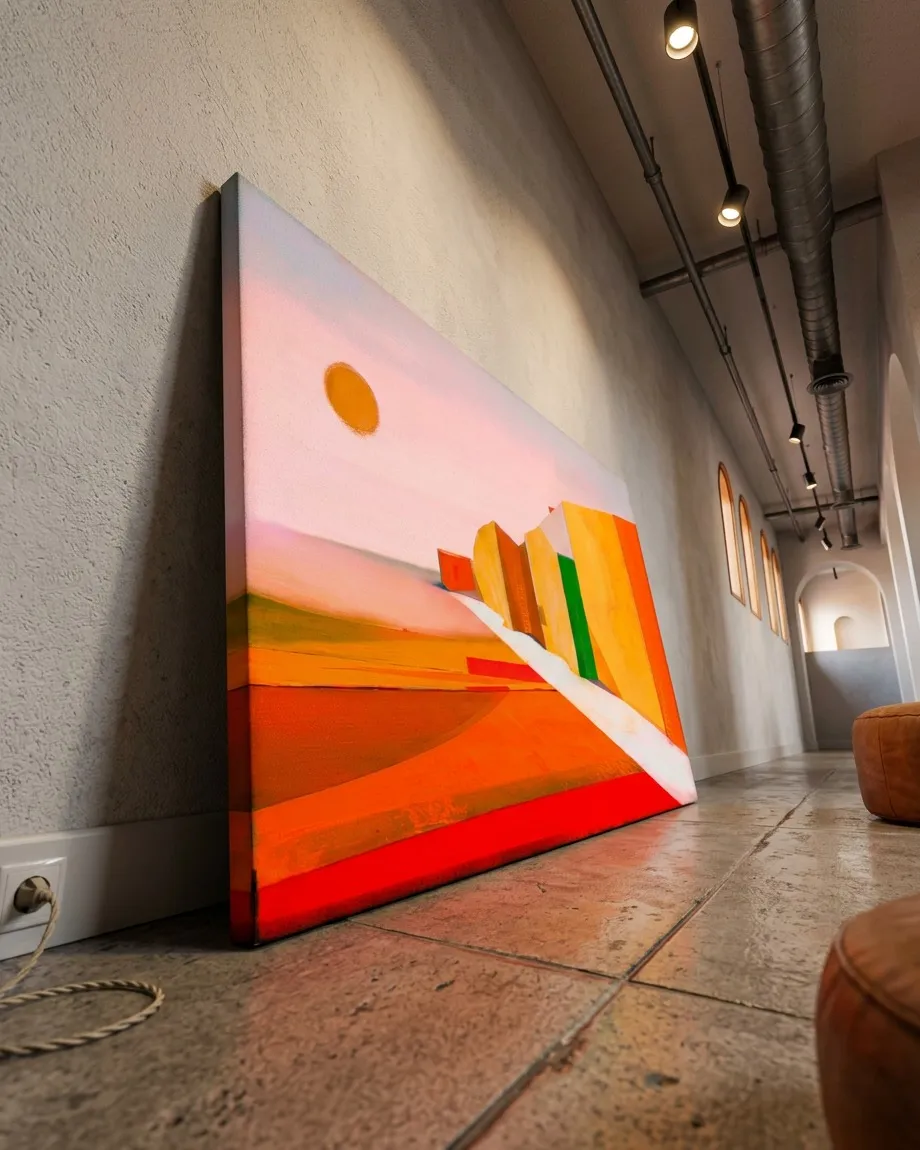
From a low angle, Maurizio Valch's painting 'VIA SOLIS' is grounded on the floor of an industrially-styled corridor. The composition unfolds in layers of vibrant oranges, warm yellows, and earthy reds that build monolithic forms. Upon this foundation, a prominent diagonal path of pure white traverses the canvas, marking a profound division and guiding the perspective towards elements that blur into the distance. Small, ladder-like incisions are discernible in some of the yellow structures, while a solar disc suspended in a pale, almost lavender sky, completes the chromatic tension. The environment, with its concrete walls and raking light, enhances the artwork's texture and material depth, inviting a sober contemplation of its structure. The persistent white path reintroduces the eye to spatial stillness.
- Original artwork
- VIA SOLIS
- Actual dimensions
- 120 × 80 cm / 47.2 × 31.5 in
- Presentation
- Digital contextual visualization
Context references
Original contemporary abstract painting · Maurizio Valch artwork · Territorial abstract art · Acrylic and oil painting on canvas · Large format horizontal artwork · Painting with warm orange and yellow colors · Minimalist geometric art · Brutalist painting for collectors · Buy contemporary abstract art · Textured canvas with stratified surface · Artwork with white diagonal path and structures · Art for modern interior design · PRIMORDIUM series painting · 120 x 80 cm artwork for acquisition · Art evoking abstract landscapes · Painting with suspended elements
About this visualization
This visualization places the artwork within an architectural context to help collectors and viewers imagine its presence in a real space. It is an interpretive reference, not an exact reproduction: the original work remains the sole authority for scale, color, surface and material presence.