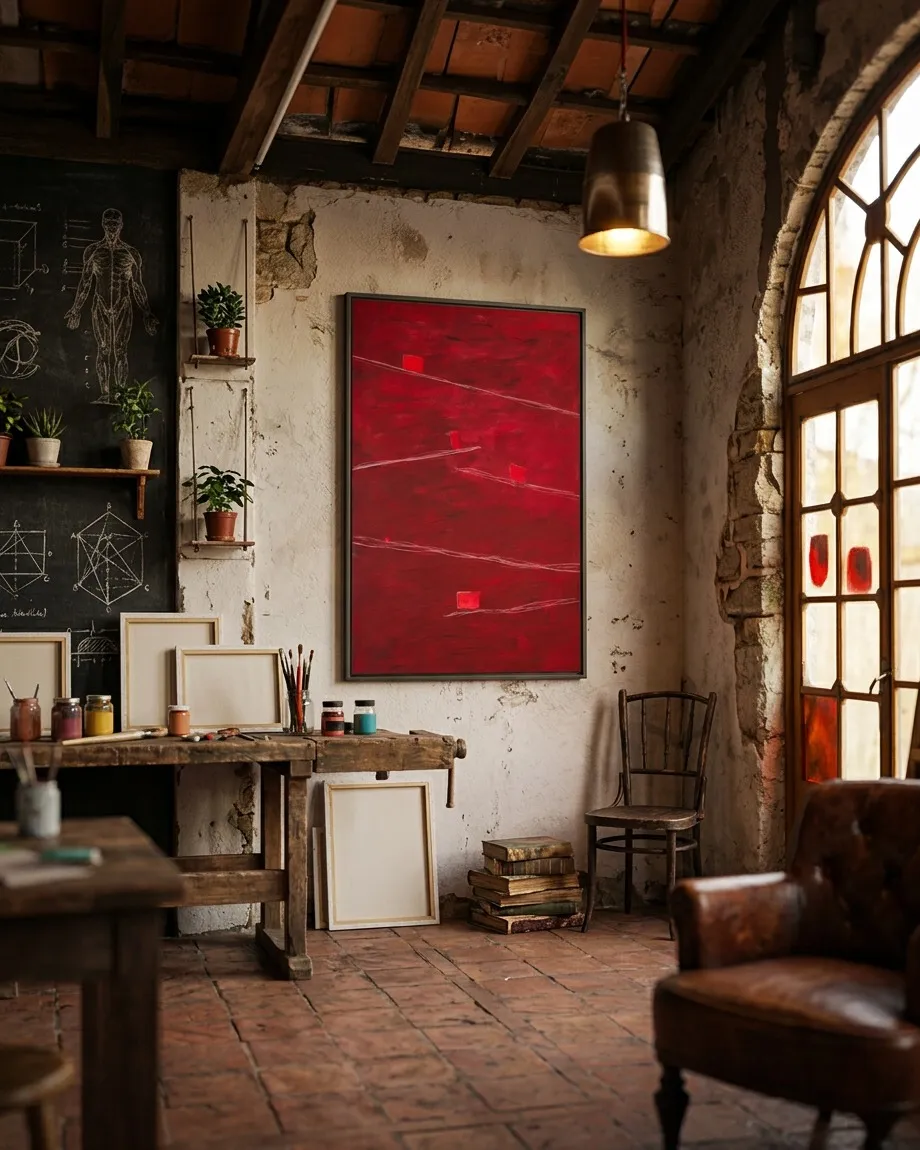
Context study / STRATA IV — DECLIVIS
STRATA IV — DECLIVIS — Context Study
An imposing aged masonry wall, its surface revealing the traces of time and history, serves as a backdrop for Maurizio Valch’s STRATA IV — DECLIVIS. The vertical artwork, measuring 80 x 120 cm, integrates with a structural presence into this atelier space. Exposed wooden ceiling beams and an irregular terracotta floor define a robust architectural setting. Light, filtered through a wide arched window, illuminates the painting's crimson field, highlighting its incisions and blocks. This environment, where historical patina dialogues with contemporary abstraction, emphasizes the artwork's connection to territory and matter in its most elemental manifestation.
- Original artwork
- STRATA IV — DECLIVIS
- Actual dimensions
- 80 × 120 cm / 31.5 × 47.2 in
- Presentation
- Digital contextual visualization
Context references
Contemporary abstract painting · Original Maurizio Valch artwork · Vertical minimalist art · Acrylic and oil painting on canvas · XL abstract artwork · Textured crimson red painting · Contemporary territorial abstraction · Painting with incisions and blocks · Art for private collectors · Brutalist painting for modern spaces · Acquire original abstract art · Vertical artwork 80x120 cm · Contemporary interior design painting · Abstract painting with stratified depth · Contemporary art for architects · Painting with compositional tension
About this visualization
This visualization places the artwork within an architectural context to help collectors and viewers imagine its presence in a real space. It is an interpretive reference, not an exact reproduction: the original work remains the sole authority for scale, color, surface and material presence.