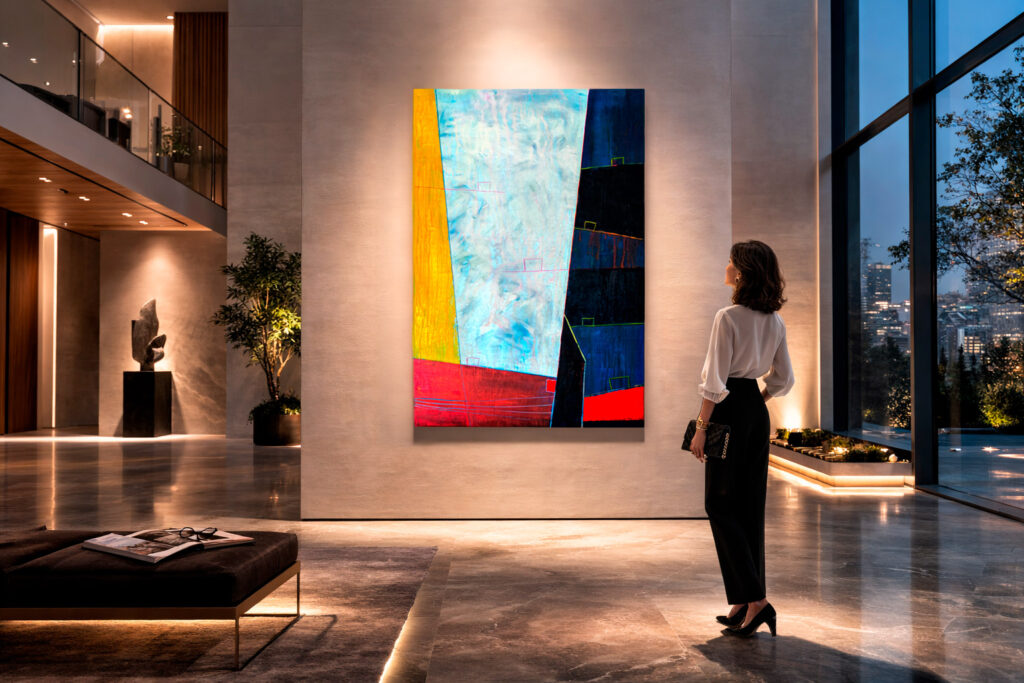
Architectural Abstract Painting – Architectural Mapping of Consciousness: Monolith, Horizon and Structured Silence
A Territory Built Through Structure
This work does not represent a place. It constructs one.
Rather than representing a landscape, the painting constructs a territory where perception is organized through structural elements: horizon, vertical mass, segmentation, and subtle traces of passage.
The composition is not expressive in a gestural sense.
It is structural.
Monolith as Point of Genesis
The vertical form operates as a monolithic presence — not as an object, but as a condensation point within the field.
It marks a place where something begins.
A point of emergence.
In this sense, the monolith is not imposed onto the territory.
It appears from it.
Horizon as Stabilization
The horizontal division is essential.
It does not describe space — it stabilizes it.
The horizon acts as an organizing force, allowing the viewer to enter the painting rather than remain outside of it. It establishes a field where verticality and depth can coexist without collapse.
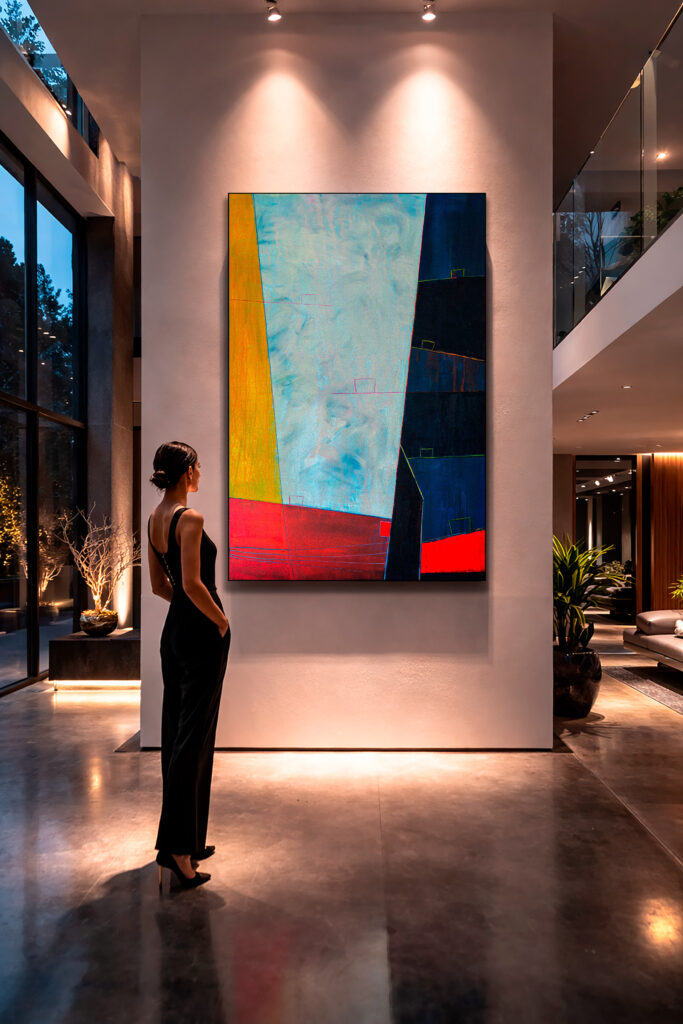
Segmentation and Passage
The surface is structured through planes and subtle incisions.
These traces suggest movement, but not in a narrative sense.
They indicate passage.
A way through.
The staircase is not explicitly drawn, but it is present as a structural possibility — an inscription within the territory.
Silence as Construction
This painting does not aim to communicate through impact.
It is built to sustain silence.
If the color were removed, the structure would remain.
If the gesture were removed, the space would still hold.
This is the core of the work:
not expression, but permanence.